
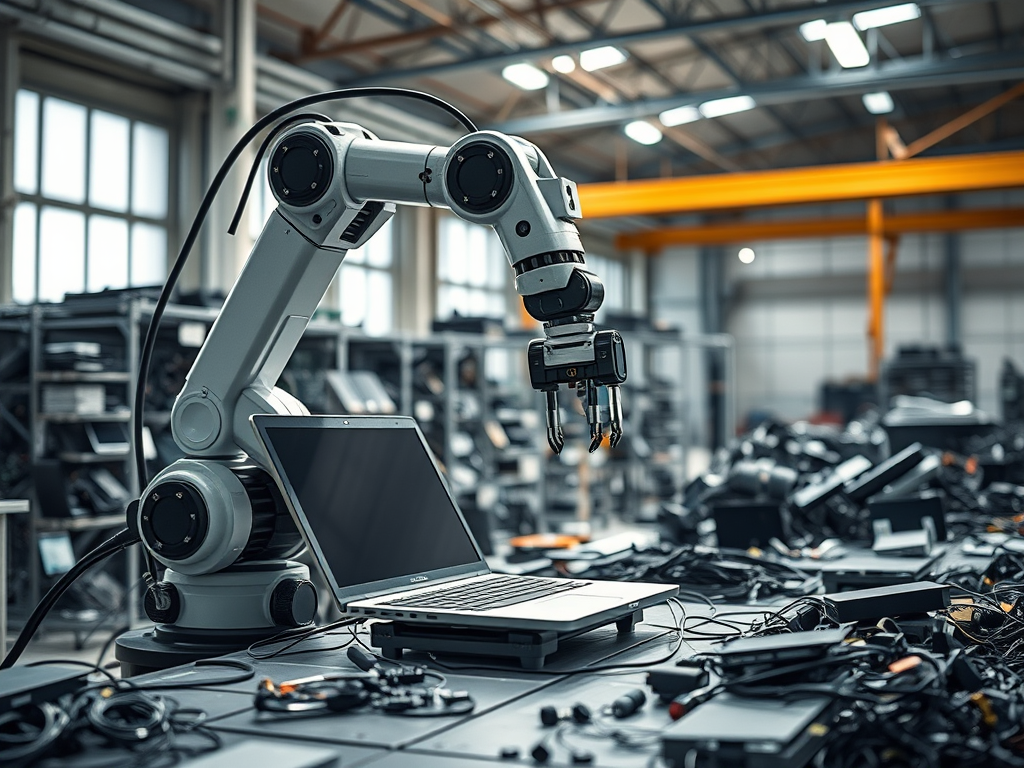
An innovative robotic recycling project from Denmark is pointing the way to a future where technological scrap becomes a valuable resource, offering a promising response to the growing e-waste crisis.
The accumulation of discarded technological devices represents one of the most critical environmental challenges of our era. Currently, an alarming 78% of these appliances do not enter proper recycling streams, worsening a problem of global magnitude. In 2024 alone, the manufacture of 1.22 billion new smartphones, combined with the mass production of computers and televisions, fuels an unsustainable cycle of consumption and disposal.
According to United Nations projections, the generation of this waste will reach 80 million tonnes by 2030. Eric Ingebretsen, Commercial Director of SK Tes, a leader in managing technological assets, illustrates this scale by stating that this is “enough to fill 1.5 million 40-tonne trucks, a line that could circle the planet.” Faced with this scenario, it is urgent to implement management solutions that not only mitigate the environmental impact but also create new economic opportunities.
The Response of Intelligent Automation
At the Danish Technological Institute, a team of scientists is developing a robotic system guided by artificial intelligence designed to transform the tech recovery industry. Mikkel Labori Olsen, a researcher on the RoboSAPIENS project, explains that their creation automates the repair of laptops, a task that is currently manual, time-consuming, and difficult for local businesses to staff.
The system integrates a robotic arm, a specialized toolbox, and machine vision, allowing it to perform screen replacements with precision. “We can drastically reduce waste if, instead of discarding a functional machine, we simply change the screen and prepare it for resale,” Olsen notes. The robot can already work with several laptop models, and the team continues to expand its capabilities.
The Hidden Economy of Digital Scrap
The economic incentive is considerable. While the material value of a laptop shredded for basic recycling is around 10 euros, that same device, once refurbished, can reach a market value of around 200 euros. “The key is that by replacing specific and simple components, we can recover a value far greater than mere material recycling,” adds Olsen.
However, the path is not without obstacles. Training the artificial intelligence to handle the vast variety of models, components, and unforeseen events—from screws of different colors to non-standard assembly methods—represents a complex technical challenge. Therefore, these systems are designed to operate in collaboration with humans, who intervene to resolve unusual situations.
Why Does It Remain an Underutilized Resource?
The opportunity is immense. A report from the Astute Group reveals that a tonne of discarded smartphones contains a higher concentration of gold than a tonne of gold ore. In addition to this precious metal, this waste contains copper, silver, palladium, and rare earth elements, all essential for manufacturing new devices.
Despite this potential, the industry does not fully exploit it. Olsen identifies two main barriers: the still nascent awareness of this market’s value and the high costs and complexity of advanced robotics. Furthermore, the trend for manufacturers to solder or glue components—instead of using screws—makes disassembly without damage extremely difficult.
Despite these challenges, optimism prevails. Companies in Denmark and internationally are demonstrating that refurbishment can be a scalable business, with aspirations to renew thousands of units daily. Olsen’s team plans to continue refining their robot to recognize more models and become a production tool for local businesses.
The conclusion is clear: robotics is destined to be a fundamental pillar of the future circular economy. By automating dangerous and meticulous tasks, these systems not only improve efficiency and safety but finally allow us to access the technological gold mine hidden within our waste.
By: Nestor Castillo, ForAllTechNews Director