
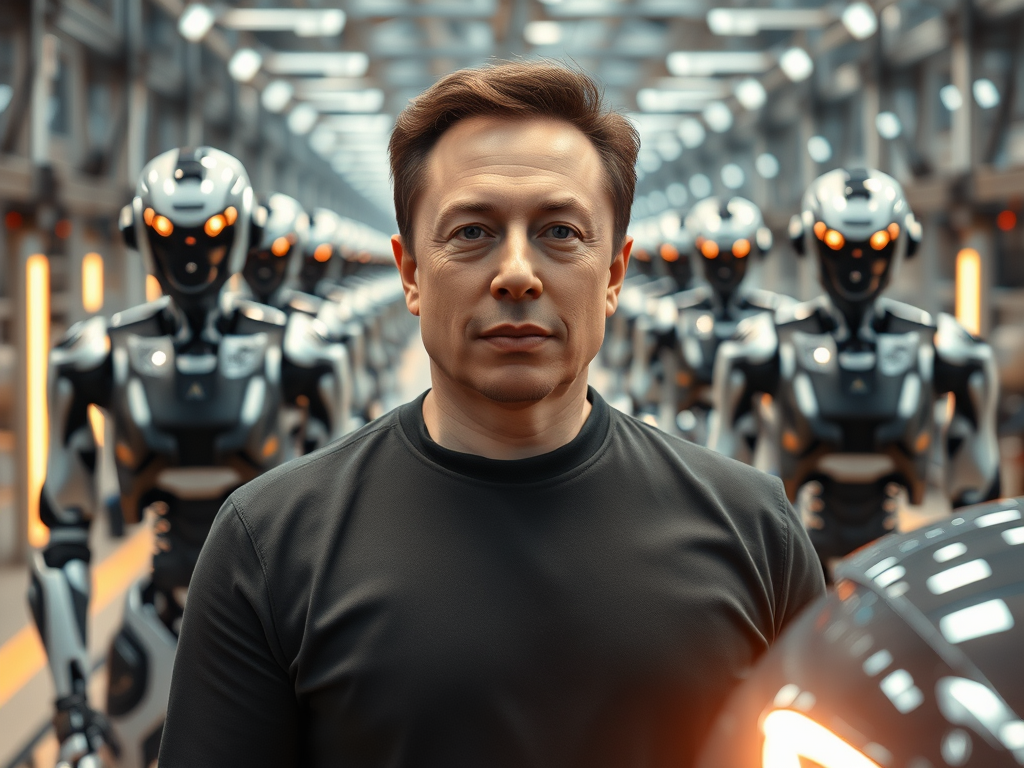
While Tesla is experiencing a moderate recovery in its core business, Elon Musk’s attention is focused on a more ambitious goal: developing what he describes as an “army of robots.” This strategic shift coincides with the effort to deliver on his long-awaited promise of autonomous vehicles, a crucial milestone for accessing his proposed $1 trillion compensation package.
The contrast between the company’s current auto manufacturing operations and its future vision based on artificial intelligence has become notably more pronounced.
Recent Results: Volume Doesn’t Always Mean Profitability
In the third quarter of 2025, Tesla reached a milestone by delivering 497,099 vehicles, driven primarily by expiring U.S. tax incentives. This rebound generated $21.2 billion in automotive revenue, the highest figure in over a year. However, this record volume did not translate into solid profitability: earnings were $1.4 billion, 37% lower than the same period the previous year.
Several factors explain this discrepancy:
- A 50% increase in operating expenses, allocated to AI projects and R&D.
- Restructuring costs of nearly $240 million, possibly linked to the cancellation of the Dojo supercomputer project.
- An impact of approximately $400 million due to trade tariffs.
Musk’s Vision: Beyond the Automobile
Musk has tried to redirect the attention of shareholders and investors toward what he considers Tesla’s future: a global fleet of robotaxis and the Optimus humanoid robot. Although he acknowledged the project’s technical complexity—”Bringing Optimus to market is incredibly difficult”—he did not hesitate to highlight its transformative potential, suggesting it could “create a world without poverty” and even perform high-precision surgery.
However, the company provided limited details on these programs in its latest report. Musk mentioned that the third version of Optimus could enter production by early 2026, a timeline that contrasts with his previous promises to manufacture thousands of units by the end of 2025.
Growing Investment and Compensation Pressure
The focus on AI and robotics will lead to a significant increase in spending and investment for 2026, including higher labor costs to retain specialized talent. This context frames the upcoming vote on Musk’s compensation package, valued at $1 trillion. Although advisors like ISS and Glass Lewis have recommended rejecting it, its approval is expected given shareholders’ historic support.
Musk, for his part, has directly linked the package’s approval to his continued leadership of the company, stating that he needs “voting control” to feel secure developing advanced technology at Tesla. In his own words: “I don’t feel comfortable building an army of robots here and then being ousted based on recommendations that don’t understand the scope of what we are doing.”