
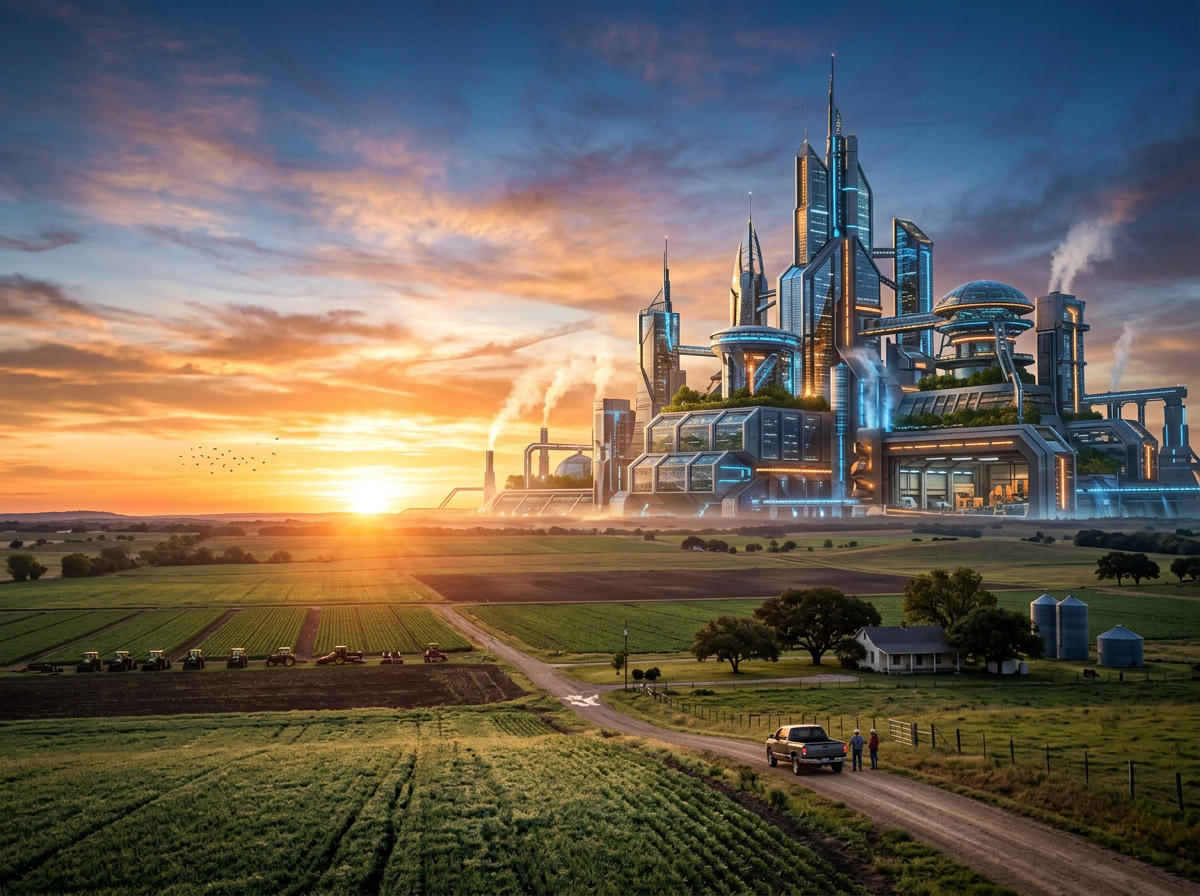
Billionaire Elon Musk has broken ground on Terafab, a semiconductor plant in Texas that, with an initial investment of $16.8 billion, seeks to shatter every industry blueprint. The facility, conceived to supply the artificial intelligence needs of Tesla and SpaceX, faces off against consolidated giants and local skepticism.
In the rural heart of Grimes County, an hour’s drive from Houston, what Elon Musk calls “the most epic chip-building effort” on the planet is beginning to rise. And for good reason. The factory, dubbed Terafab, aims to become the most expensive and expansive structure ever erected by humanity, with a first phase alone exceeding $16.8 billion and a potential expansion that, according to internal documents, could scale up to $119 billion.
The project, driven jointly by SpaceX and Tesla, is no simple assembly plant. It will occupy over 100 million square feet—the equivalent of a small city—and concentrate within a single complex the creation, packaging, and testing of advanced memory and logic chips. Musk has described it as the “science fiction city” he always wanted to build.
Technological Self-Sufficiency in the Face of Unstoppable Demand
The decision to erect this industrial behemoth is not an aesthetic whim but an arithmetical necessity. Projections from both companies indicate that in the coming years, they will require more than a terawatt of processing capacity—a figure that the global semiconductor supply chain alone cannot guarantee. Faced with the impossibility of sourcing from the market, Musk has opted for the most extreme route of vertical integration: manufacturing his own microchips.
According to disclosed plans, 25% of Terafab’s output will go toward powering the electronic brains of Tesla’s Optimus robots and Cybercab autonomous vehicles. The remaining 75% will drive SpaceX’s orbital data centers, Musk’s central bet for the future of connectivity and space-based computing.
A Giant Among Giants
The challenge is monumental. Terafab squares off directly with industry titans such as Samsung, SK Hynix, Micron, and the all-powerful TSMC. The company has enlisted support from Intel, though the scope of its involvement remains a mystery. Early job postings suggest the plant will focus its efforts on the memory market—a key segment where Musk hopes to make a difference.
However, the project contains clauses that temper its solidity. In SpaceX’s own IPO presentation, Terafab appears defined as a “general framework”—an agreement that allows either party to withdraw without penalties. This flexibility has raised alarms among investors, already burned by the runaway spending on artificial intelligence by other tech giants like Google and Meta.
Friction in the Heart of Texas
While Musk gazes skyward and at algorithms, the residents of Grimes County are looking at the ground and the faucet. Nearly 900 locals have signed a petition demanding strict oversight of the project’s environmental impact, especially regarding water and energy consumption. To calm tensions, SpaceX has promised an annual injection of $20 million to the region, the use of reservoir water (rather than drawing from groundwater), and its own gas-powered generation to avoid overburdening Texas’s already fragile power grid—which the governor recently froze for new data centers.
The gap between Musk’s visionary manifesto and the roar of bulldozers in the Texas dust is enormous. Terafab, for now, is a giant of concrete and promises that has yet to produce a single chip. But in its creator’s mind, it harbors the ambition to possess, all at once, control over hardware, software, and outer space. The world watches to see whether this leap into the industrial void becomes a milestone or a titanium mirage.
ForAllTechNews