
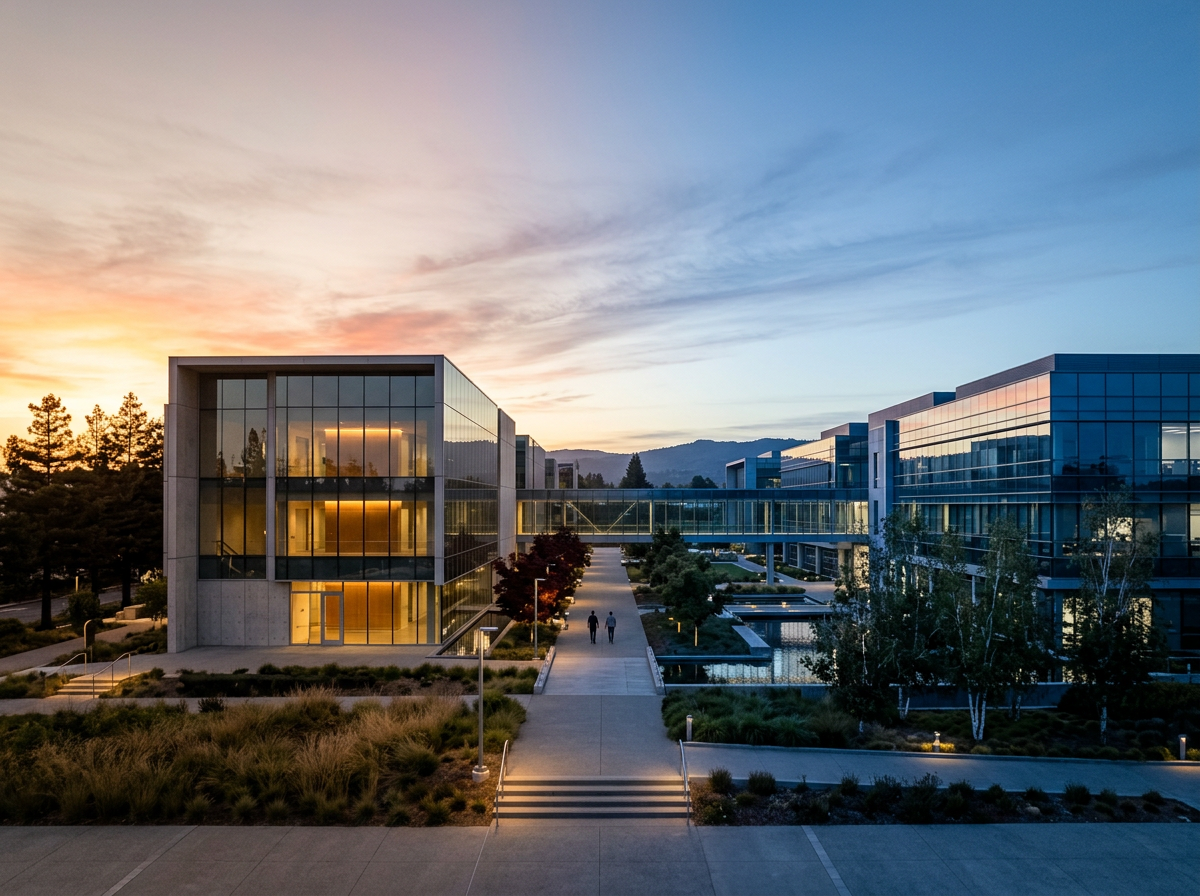
Cupertino, California — On Tuesday, Apple awoke with a new face at the helm. John Ternus, a 51-year-old mechanical engineer and company veteran since 2001, became the eighth chief executive officer in the firm’s history, succeeding Tim Cook, who for fifteen years piloted the company to transform it into a financial titan worth $4.6 trillion.
The transition, anticipated for months, has materialized with an unusually symbolic gesture. In his farewell memo to staff, Cook barely mentioned products, Asian markets, or artificial intelligence. His message was a tribute to corporate culture, a nod to the mystique of the bitten apple that Steve Jobs knew how to sculpt. “This place is proof that culture triumphs over everything,” wrote the outgoing executive, who reached for Jobs’ famous metaphor about leaving “a dent in the universe” to seal his goodbye.
Curiously, it was the same phrase Ternus used two years ago in a commencement address at the University of Pennsylvania, his alma mater. The coincidence does not seem accidental: the new CEO, the first engineer to occupy Jobs’ chair since the co-founder’s death, has built his career in design workshops, not in boardrooms. His technical profile contrasts with Cook’s operational and logistical background, but both share an almost religious devotion to Apple’s internal ecosystem.
The Titan’s Legacy: Numbers That Stagger
If the Cook era is measured in figures, the balance is staggering. When he took office in August 2011, Apple was worth less than $350 billion, and annual revenue hovered around $157 billion. Today, the company exceeds $4.6 trillion in market capitalization and projects closing the fiscal year with $477 billion in revenue. The services segment, which back then was a footnote, now generates over $109 billion annually, representing a quarter of the business.
Bank of America analysts made a dizzying calculation: during Cook’s tenure, Apple added market value at a rate of $32 million per hour, every hour, for nearly 15 years. A pace that only the iPhone and Cupertino’s commercial machinery have been able to sustain.
Nevertheless, Cook wanted his final word not to be about balance sheets. In his post on social media platform X, which garnered 24.2 million views—and a congratulatory reply from Elon Musk—he wrote: “My title changes tomorrow, but my love for the Apple community never will.” And he made it clear he is not leaving: he will remain as executive chairman, focused on institutional and political relations, with Donald Trump and Beijing as his primary interlocutors.
The Succession: An Engineer with an Eye on Design
John Ternus is not a man of grandiloquent speeches, but neither is he a novice in the spotlight. For over a decade, he has been the public face of hardware launches, overseeing every generation of iPad, AirPods, Mac lines, and the recent iPhone Air and MacBook Neo. His obsession, according to close sources, is to restore the greatness of Apple’s design studio, decimated after the departure of Jony Ive and his closest collaborators.
In his 2024 address to engineering graduates, Ternus offered them a maxim that now resonates as a statement of principle: “Always assume you are as smart as anyone else in the room, but never assume you know as much as they do.” He confessed to having arrived at Apple at age 26 feeling like an intruder among geniuses, and encouraged the young graduates to “go and make a dent in the universe.” Today, he himself has the opportunity to do so from the top.
Immediate Challenges: AI, Talent Drain, and a Leadership in Transition
The new CEO does not inherit a bed of roses. Artificial intelligence is the primary headache: Apple has delayed the renovation of Siri and has had to turn to Google’s Gemini to underpin its next version—a decision that analysts read as pragmatism or as a sign of weakness, depending on the perspective.
Moreover, the talent drain is unprecedented. More than 400 former Apple employees now work at OpenAI, according to an internal lawsuit filed by the company itself. The heads of mixed-reality and smart-home hardware have emigrated to competitors like Oura and OpenAI itself. In August, Ternus already executed a cut of over 200 positions in the Siri and Vision Pro teams and has restructured the executive echelon: he has brought back retired vice president Laura Legros, brought in Nate Gatten from American Airlines, and overseen the departure of key figures such as Kate Adams and Apple Pay director Jennifer Bailey. Nearly half of the executive team is approaching retirement age.
The most symbolic move came on Monday, when Phil Schiller handed over management of the App Store to Eddy Cue, in what appears to be a strategic realignment of key areas.
The Crucible: The Foldable iPhone and Cook’s Shadow
Ternus has barely eight days before his first major test: the September 9 iPhone event, where the company’s first foldable device is expected to be unveiled. It will be his baptism by fire before the world, and the first barometer of his ability to lead without his predecessor’s safety net.
But Cook’s shadow looms large. As executive chairman, he will remain in the building, and experts are already wondering what will happen when the two disagree on direction. David Yoffie, a professor at Harvard Business School, raised the dilemma in remarks to The New York Times: “Will Tim be comfortable if John decides to invest massively in AI, revive the autonomous car project, or bury the Vision Pro? And will John be comfortable making those decisions with Tim watching?”
For now, there are no signs of friction. At the farewell party organized by Apple, Cook assured that both are committed to making this “the best transition in history.” History, however, will be written in the coming months. And the first chapter is being written this week, in Cupertino, with a 51-year-old engineer at the wheel and a $4.6 trillion legacy in the rearview mirror.
ForAllTechNews