
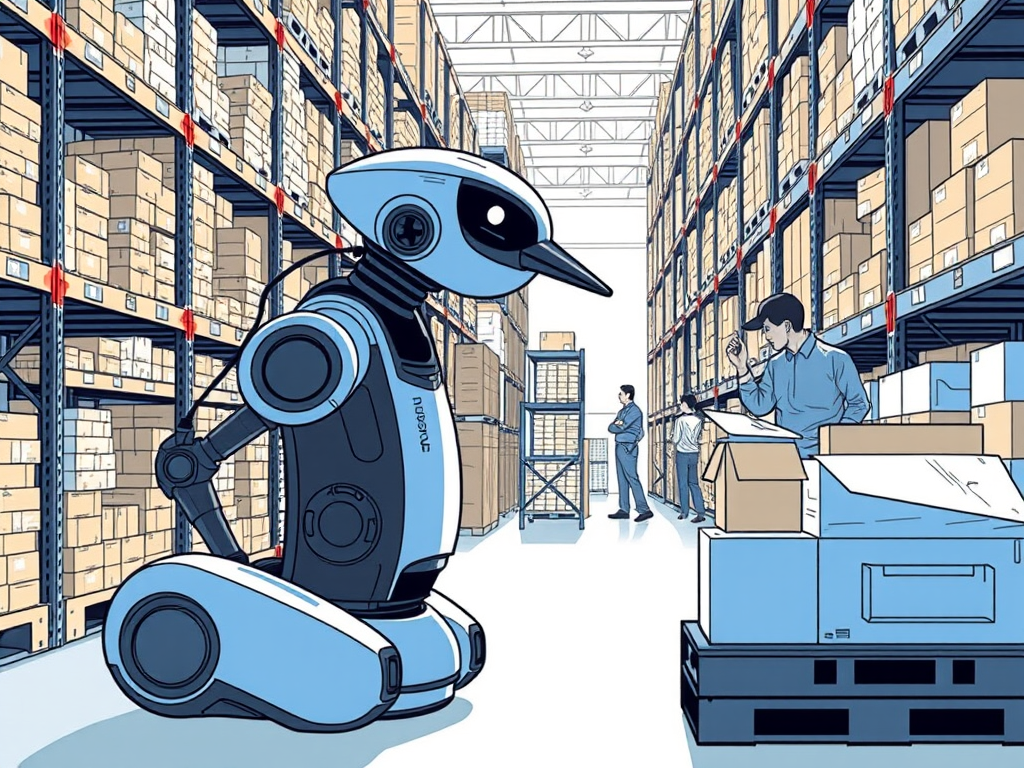
In its distribution centers across the United States, Amazon continues to integrate advanced technological solutions designed to work alongside its employees. These systems address some of the biggest challenges in modern logistics, such as delivery speed and the application of sustainable artificial intelligence. The company recently introduced two significant advancements: the Blue Jay robot and Project Eluna, initiatives that, according to Amazon, enhance the safety and productivity of its operational teams.
Tye Brady, Chief Technologist at Amazon Robotics, emphasized the purpose of these innovations: “Our latest solutions demonstrate how AI and robotics can enhance the experience for both employees and customers. Technology becomes a fundamental tool for making work safer, smarter, and more satisfying.”
Blue Jay: A Multifunctional Robot that Streamlines Processes
Blue Jay represents a leap in industrial robot design, combining three key logistical operations—picking, stowing, and consolidating products—into a single automated system. According to Amazon, this integration consolidates multiple assembly lines into a compact space, increasing operational efficiency and providing tangible support to workers.
The company states that Blue Jay can handle approximately 75% of the variety of items stored in its facilities.
One of the most notable achievements is the robot’s record-breaking development time: it moved from the concept stage to production in just over a year, a timeline significantly shorter than the three years or more required for previous models like Robin, Cardinal, or Sparrow. This acceleration was made possible by applying artificial intelligence, which compressed years of testing and adjustments into mere months.
“Our engineering teams were able to test dozens of Blue Jay prototypes using digital twins,” the company explained. “This is an advanced simulation technique that, by applying real-world physics, allows us to experiment and validate designs virtually.” By combining these simulations with AI, data analytics, and the accumulated experience from its current robot fleet, Amazon has managed to develop smarter robotic systems in less time.
Blue Jay is currently in the testing phase at a facility in South Carolina. Its implementation allows employees to shift their focus from physically repetitive tasks—like manual stowing—toward higher value-added functions, such as quality control and issue resolution. This change not only reduces physical strain on staff but also speeds up order delivery for customers.
It is worth recalling that earlier this year, Amazon announced the deployment of its one-millionth robot at a facility in Japan, joining a global network spanning over 300 centers. Furthermore, with the introduction of its DeepFleet model, the company expects to improve its robotic fleet’s travel times by 10%, leading to faster and more cost-effective deliveries.
Project Eluna: Predictive AI for Warehouses
On the other hand, Project Eluna introduces an agent-based AI model that redefines warehouse management. This platform processes historical and real-time information from the entire facility, using natural language to provide actionable insights that facilitate decision-making.
This tool allows operators to anticipate bottlenecks and design proactive strategies without needing to consult dozens of disparate control panels. Eluna is currently being implemented at a facility in Tennessee for the holiday season, where it is expected to optimize sorting processes. In the future, it will also contribute to preventive safety measures, such as planning ergonomic shift rotations and improving maintenance programs.
This system not only frees operators from constant monitoring tasks but also allows them to focus on training their teams. The result is a safer work environment and more agile, well-informed decision-making across Amazon’s entire operational network.