
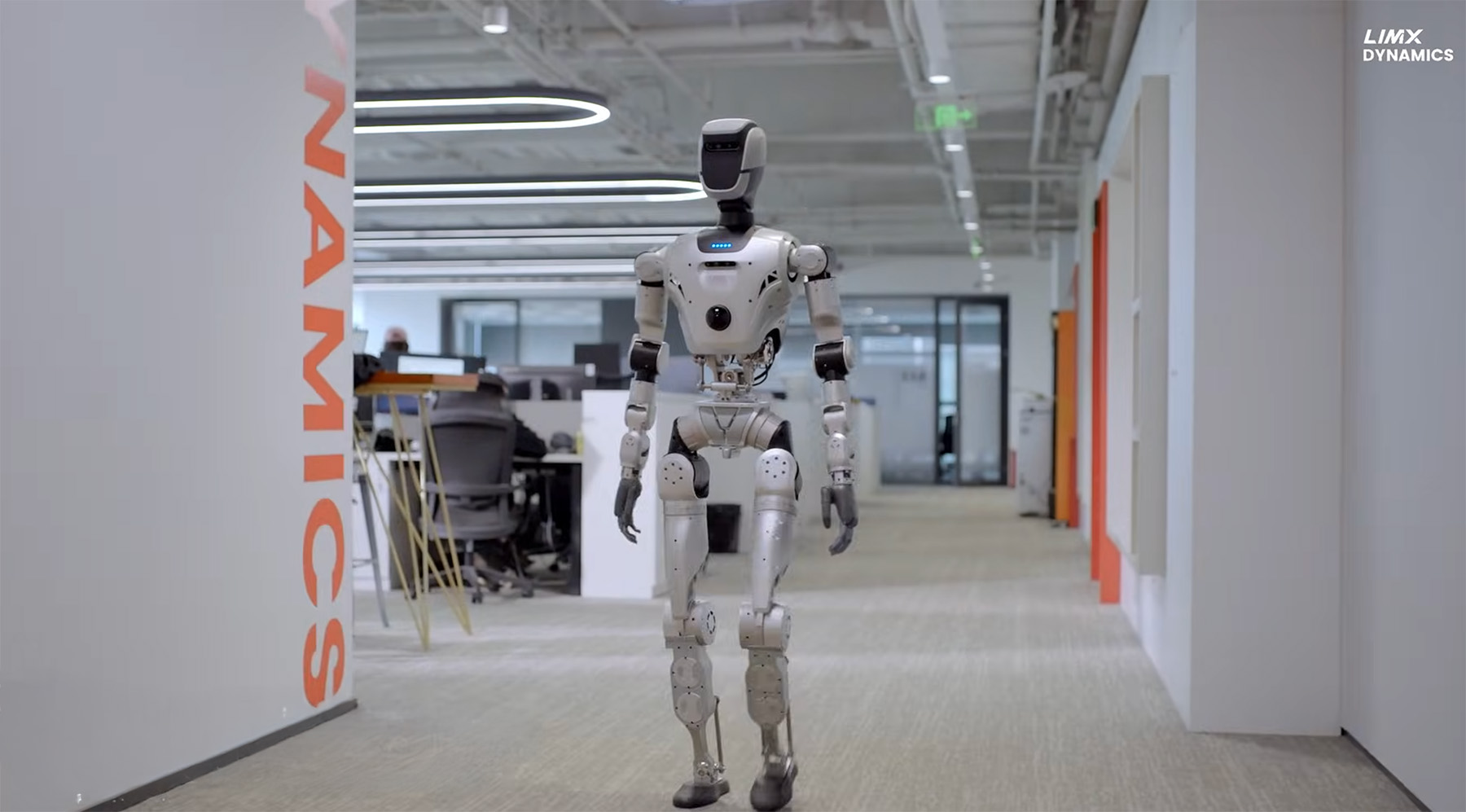
The race to commercialize humanoid robots continues to attract significant investment. LimX Dynamics, a startup in the sector, announced this week the closing of a Series B funding round worth 200 million U.S. dollars. According to the company, these resources will allow it to intensify both research and development and its commercial deployment, with support from new and existing shareholders, as well as partners within the tech ecosystem.
Based in Shenzhen, China, the firm describes itself as an innovation engine in the field of general-purpose humanoids and the development of modular robotic platforms. “Through the continuous improvement of our product engineering and the strengthening of our supply chain, we are accelerating our expansion in both domestic and international markets,” the company stated.
Founded in 2022, LimX Dynamics focuses its efforts on creating full-scale humanoid robots equipped with embodied artificial intelligence, with the stated goal of materializing Artificial General Intelligence (AGI) in physical environments. Its technological strategy rests on three fundamental pillars: the design and manufacturing of robotic hardware, foundational models for motion control, and an agent operating system specifically designed to interact with the real world.
The company emphasizes that its approach integrates advanced cognitive planning capabilities with a coordinated whole-body motion control system. Two of its recent developments, the TRON 2 platform and the LimX COSA operating system, have reportedly generated notable interest within the industry.
TRON 2: A Versatile Platform for Testing and Development
The TRON 2 platform is characterized by its modular architecture, which allows its limbs to be reconfigured to function as manipulator arms or as legs for locomotion. This unified design, LimX explains, offers developers and industrial users the flexibility to adapt the robot to various applications without the need for specific hardware modifications for each task.
Introduced in late 2025, TRON 2 is defined by the company as a fundamental, reusable, scalable, and constantly evolving robotic platform that advances alongside progress in robotics and AI.
LimX COSA: The Operational “Brain” for Robotic Autonomy
Concurrently, LimX Dynamics has built the COSA operating system from the ground up, conceived to equip robots with the ability to operate autonomously in physical environments. This system fuses high-level reasoning and decision-making with precise whole-body motion control.
Thanks to COSA, the company’s “Oli” humanoid can operate without relying on predefined scripts. The operating system manages models, cognitive skills, and hardware components in a unified manner, which, according to LimX, allows robots to execute complex tasks independently. Oli can interpret instructions, perceive its surroundings, plan action sequences, and modify its behavior in real-time to navigate dynamic situations.
An International Consortium Bets on the Future of Robotics
LimX Dynamics’ Series B round saw participation from prominent Chinese and global investment funds, such as Stone Venture, JD.com, Oriental Fortune Capital, and CoStone Capital. Existing backers also joined, including Shangqi Capital (linked to SAIC Motor), NIO Capital, and Future Capital.
“At a decisive moment for physical artificial intelligence, LimX Dynamics remains committed to foundational innovation, supported by robust product development and a principle that prioritizes customer needs,” the company stated. “In collaboration with partners worldwide, we are advancing the validation and practical application of robots, ensuring that technological progress ultimately serves people.”
This capital injection follows a previous round in which LimX raised approximately 72 million dollars. The startup is part of a trend of heavy investment in the humanoid robotics sector, which has seen significant moves in the past year, such as the $1.4 billion round for Skild AI in early 2026, the $1 billion Series C for Figure AI, or the $600 million investment in Physical Intelligence.
The sector’s dynamism was also highlighted last month by Mobileye’s announcement of its intent to acquire Mentee Robotics for $900 million. However, the challenges of large-scale commercialization persist: a recent report, citing an Omdia study, indicated that just over 13,000 humanoid robot units were shipped globally during 2025, placing companies like Agibot and Unitree at the forefront of a still-nascent market.
By: Nestor Castillo, ForAllTechNews Director