
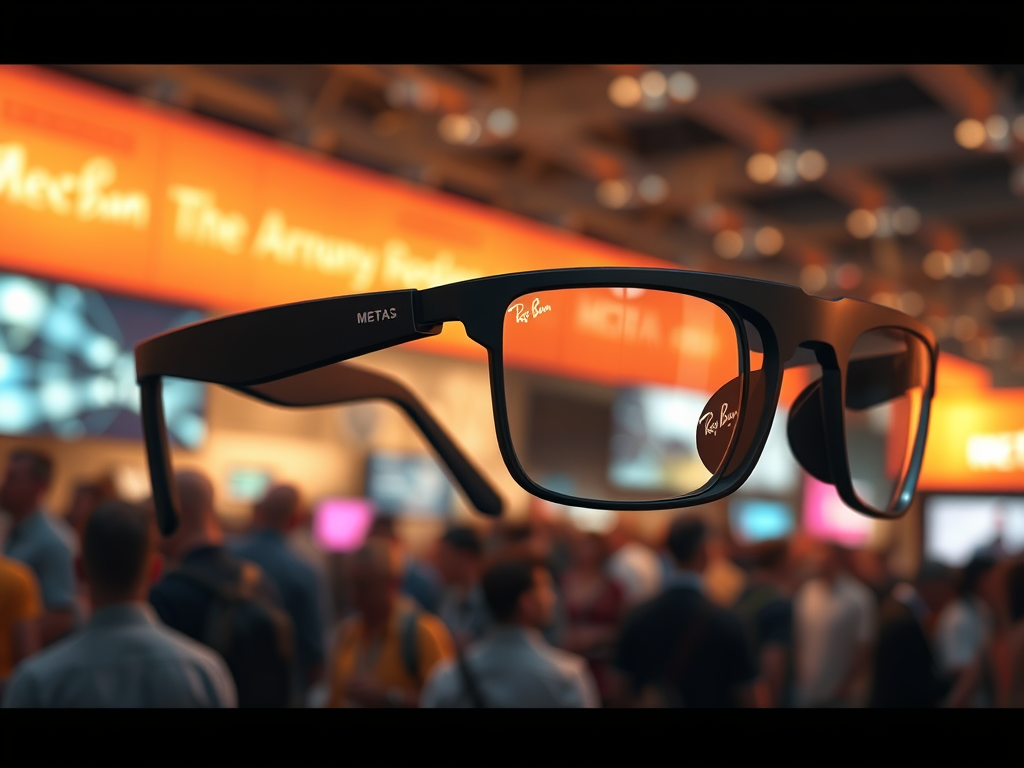
At its annual developer conference, Meta Connect 2025, the company unveiled its latest breakthrough in wearable hardware: innovative smart glasses developed in collaboration with Ray-Ban, which feature an integrated display in the right lens.
Unlike previous prototypes, this model, called the Meta Ray-Ban Display, will be available for public purchase starting September 30th for $799. The system is controlled by a wearable wristband, the Meta Neural Band, which detects the user’s hand movements using electromyography (EMG) technology, interpreting neuromuscular signals.
This launch represents a crucial step in Meta’s strategy to create its own hardware ecosystem and reduce its dependence on Apple and Google platforms. The new glasses allow users to access notifications, applications like Instagram, WhatsApp, and Facebook, as well as receive real-time translations and visual prompts directly in their field of vision.
While functionally more modest than the ambitious Orion prototype unveiled last year—which featured augmented reality lenses and eye-tracking—these glasses build on the success of their predecessor, of which millions of units have been sold. They include, in addition to the display, a camera, microphones, and speakers, along with an AI assistant with cloud connectivity.
The Neural Band wristband, with 18 hours of battery life and water resistance, acts as a discreet controller that enables interaction without the need to touch the glasses. Meta is confident that this gesture-based interface will set a new standard for interacting with wearable technology.
With this product, Meta seeks to position itself as a pioneer in the emerging smart glasses market, getting a head start on other tech giants like Apple and Google, which are expected to launch their own models in the near future. Although the latter could benefit from native integration with their operating systems, Meta is betting on establishing early adoption with an immediately available device.
A video leaked days before the official announcement had already previewed some of the features of these glasses, whose internal codename during development was “Hypernova.”