
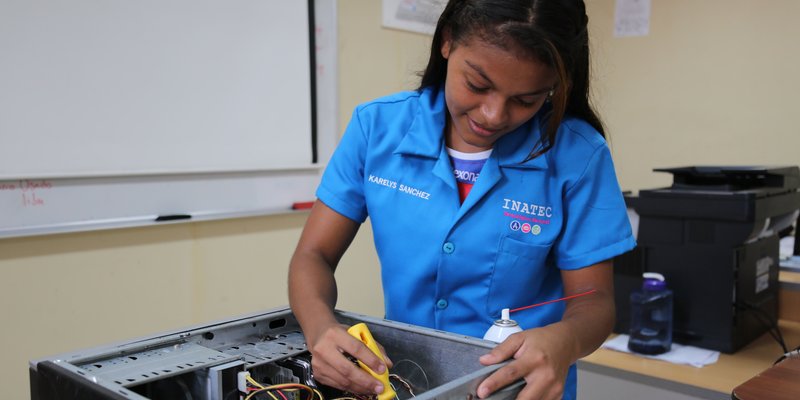
Technical education is a fundamental pillar for the economic and social development of any country. In Nicaragua, technical education has developed significantly in recent decades, but still faces some challenges that must be addressed to guarantee its sustainability and quality.
In an article I wrote many years ago about technical careers where I mentioned that young people do not willingly follow a technical career, however I am sure that it is a serious mistake, since a technician can develop all his skills and competencies by achieving This forms everything that is proposed. In the end, professionals in different areas are superior technicians and a technical career can be scalable.
We can see this in the statistics provided by the company ProNicaragua in a document on the university population in 2019 (Pages 3 and 4). Enrolled university students: 104,738 and students enrolled in technical courses: 3746, we can see the difference.
In part, companies have responsibility in this situation and that is that their hiring does not include technical careers, that is why we see job advertisements where they request a warehouse manager to be an industrial engineer or related careers, or they request a cashier to be an economist. , public accountant or related careers and the salary is very poor.
The only way out of this situation could be for young people to be trained in entrepreneurship, offering specialized services, otherwise, we will continue in the same vicious circle.
It is important to know this fact, and that before arriving in Central America, Intel did a study of the number of technicians there were in each Central American country, and Costa Rica is where there were the most technicians, so Intel decided to invest 200 million dollars to start in Costa Rica, the rest is history, there are billions that Intel has invested in this neighboring country.
Below is a brief history of technical education in Nicaragua.
Technical education in Nicaragua has its origins in the 19th century, with the creation of trade schools and craft workshops. In the 20th century, more formal educational institutions were created, such as the National Technological Institute (INATEC), which is currently the main institution responsible for technical education in the country.
In recent decades, technical education in Nicaragua has experienced significant growth. In 2023, INATEC offers more than 300 technical programs in various areas, such as health, industry, construction and services. In addition, the country has a growing number of private educational institutions that offer technical programs.

Challenges of technical education in Nicaragua
- Despite the progress made, technical education in Nicaragua still faces some challenges that must be addressed to guarantee its sustainability and quality. These challenges include:
- Lack of resources: INATEC is a public institution that depends on the State budget. The lack of resources has made it difficult to update technical programs and acquire modern equipment.
- Lack of articulation with the labor market: Technical programs must be aligned with the needs of the labor market to guarantee that graduates can find employment. However, in some cases, technical programs do not meet the needs of companies.
- Lack of social recognition: Technical education still does not enjoy the same social recognition as university education. This can discourage young people from opting for a technical career.
Opportunities for technical education in Nicaragua
- Despite the challenges, technical education in Nicaragua has great potential to contribute to the economic and social development of the country. Opportunities for technical education include:
- Economic growth: Nicaragua’s economic growth is generating new employment opportunities in areas such as industry, construction and services. This creates a growing demand for skilled technical workers.
- Technological innovation: Technological innovation is transforming productive sectors, which requires technical workers with updated skills.
- Globalization: Globalization is opening new opportunities for Nicaraguan exports. This requires technical workers who can compete in the international market.
Conclusions
Technical education is a fundamental pillar for the economic and social development of Nicaragua. To ensure its sustainability and quality, it is necessary to address existing challenges and take advantage of available opportunities.
Some measures that could be implemented to strengthen technical education in Nicaragua include:
Increase the budget assigned to INATEC: This would allow updating the technical programs and acquiring modern equipment.
Strengthen articulation with the labor market: This could be done through the participation of representatives of the business sector in the development of technical programs.
Raise social recognition of technical education: This could be done through awareness campaigns and the promotion of technical careers in educational centers.
With the support of appropriate public policies, technical education in Nicaragua can contribute significantly to the development of the country.
Néstor Castillo
Director de ForAllTech