
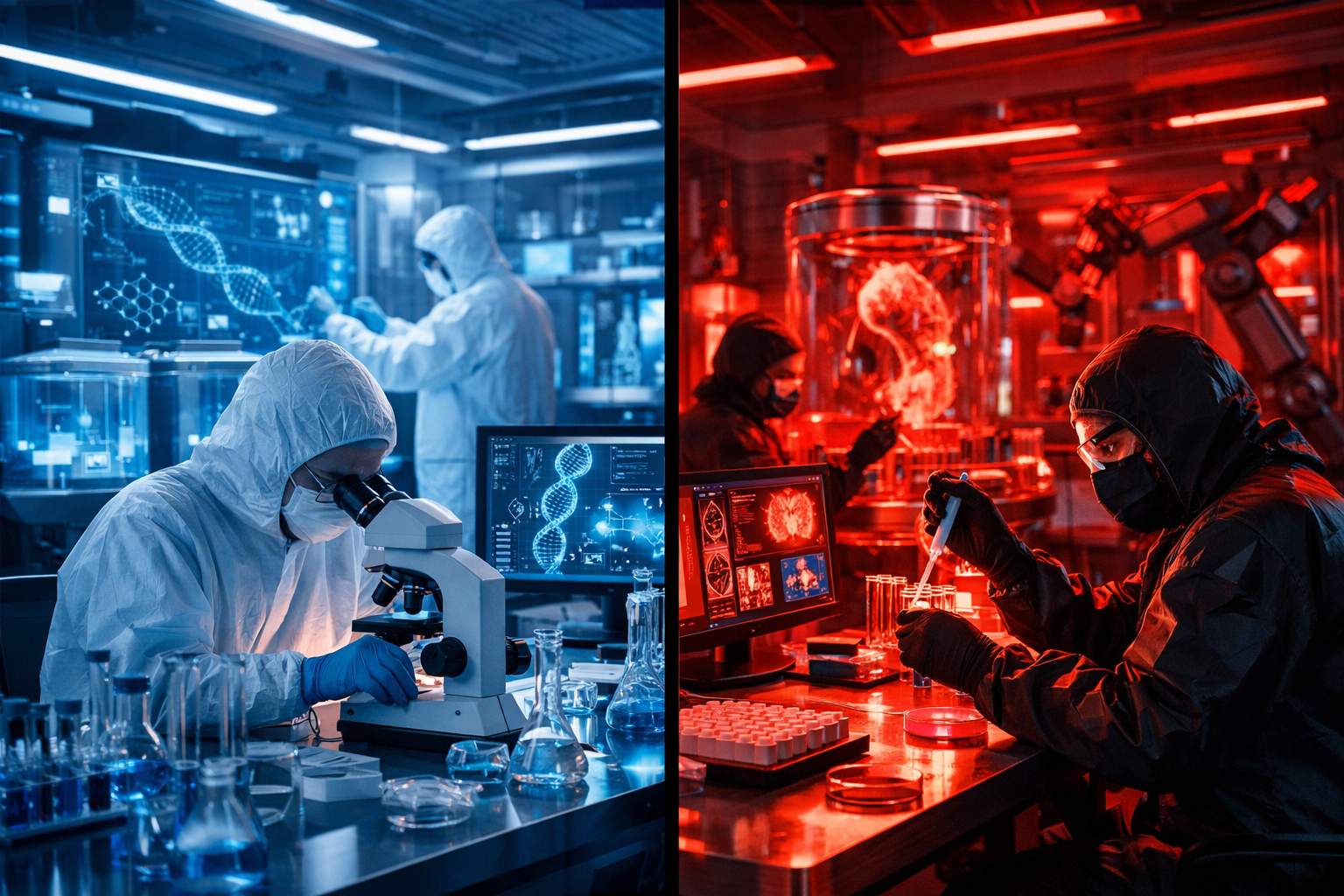
We are living through a turning point in the life sciences industry. Three seemingly disconnected events—the regulatory offensive by the U.S. National Institutes of Health (NIH), the unstoppable rise of Chinese biotechnology, and the stock market collapse of Wave Life Sciences—actually paint the same picture: the order that governed biomedical research for decades is being rewritten from the ground up.
1. The NIH Offensive: The End of Naive Collaboration
The NIH’s decision to tighten restrictions on foreign “sub-awards” is not a mere bureaucratic adjustment; it is a paradigm shift. For years, the American model was based on open meritocracy: federal funds flowed to universities and research centers, which in turn collaborated with global partners, including Chinese ones.
This new offensive, driven by national security concerns and intellectual property espionage fears, is forcing a “selective decoupling.” For U.S. academic institutions and startups, this means:
- Increased administrative burden: The bureaucracy required to justify every foreign collaborator becomes a significant drag.
- Brain drain: Scientists of Chinese origin in the U.S. face a hostile environment that pushes them to return to China, taking decades of know-how accumulated in Silicon Valley and Boston with them.
This move, intended to slow down technology transfer, is actually accelerating the competitor’s autonomy.
2. China’s Biotech Boom: Rewriting the Rules of Drug Development
While Washington builds walls, Beijing is building ecosystems. China’s “biotech boom” is no longer limited to being the world’s “API (active pharmaceutical ingredient) factory.” By 2024 and 2025, we have seen a qualitative leap toward first-tier innovation.
China is rewriting everything in three key areas:
- Speed and cost: The Chinese “fast follower” model has mutated. Companies like BeiGene, Legend Biotech, and an army of biotechs in Shanghai (Zhangjiang) and Suzhou are developing bispecific antibodies, antibody-drug conjugates (ADCs), and cell therapies (CAR-T) with development cycles up to 30% faster and at significantly lower cost than in the West.
- Out-licensing deals: The balance of innovation trade has reversed. In the last two years, European and American pharmaceutical companies have been paying billions of dollars in upfront payments to license molecules developed in China. What was once “invented in the U.S., made in China” is now “discovered in China, globalized by the West.”
- Technological self-sufficiency: Facing U.S. restrictions, China has doubled down on investment in biologics manufacturing equipment (bioreactors, chromatography columns) and AI software for drug discovery, reducing its dependence on American suppliers.
The message is clear: it’s no longer just about lowering costs, but about setting the pace of global innovation.
3. Wave Life Sciences: The Fragility of Speculative Enthusiasm
In the midst of this geopolitical reshuffling, the case of Wave Life Sciences serves as a raw reminder of the sector’s volatile nature. The company lost half its value after disappointing obesity results.
This event is symptomatic for two reasons:
- Concentration of risk: The market has disproportionately rewarded the obesity space (GLP-1 and analogues) following the success of Novo Nordisk and Eli Lilly. Wave, which attempted to differentiate itself with interfering RNA (siRNA) to preserve muscle mass during weight loss, hit the harsh reality that technical differentiation doesn’t always translate into solid clinical data.
- The Asian context: While Wave was collapsing, Chinese firms specializing in obesity and metabolism (such as Sciwind Biosciences or Eccogene) continue to sign multi-billion dollar deals with Western pharma. The lesson is that U.S. investor patience for internal projects is wearing thin, but the appetite for acquiring proven technology from China remains intact.
Conclusion: A Bipolar World of Innovation
What we are witnessing is the transition from a globalized, unipolar ecosystem (dominated by the U.S.) to a bipolar system, fragmented by geopolitics but interconnected by capital.
- The U.S. seeks to secure its intellectual supply chain through protectionism but risks isolating itself from the flow of talent and clinical data that accelerated its own science.
- China is capitalizing on this isolation to consolidate itself as the world’s most efficient innovation lab, attracting Western capital not through direct academic collaboration (which the NIH is cutting off), but through pure commercial deals.
- The market mercilessly punishes Western companies that fail to meet expectations, while the Chinese machinery continues to produce drug candidates with an industrial efficiency that the West has yet to match.
The “rewriting” mentioned in the title is not a metaphor. It is the reality that the next generation of drugs for cancer, obesity, and rare diseases will likely be born in Chinese labs, funded by U.S. venture capital, to be commercialized by European pharma. The old paradigm of open science and Western exceptionalism in biotech has become obsolete.
By: Nestor Castillo, ForAllTechNews Director