
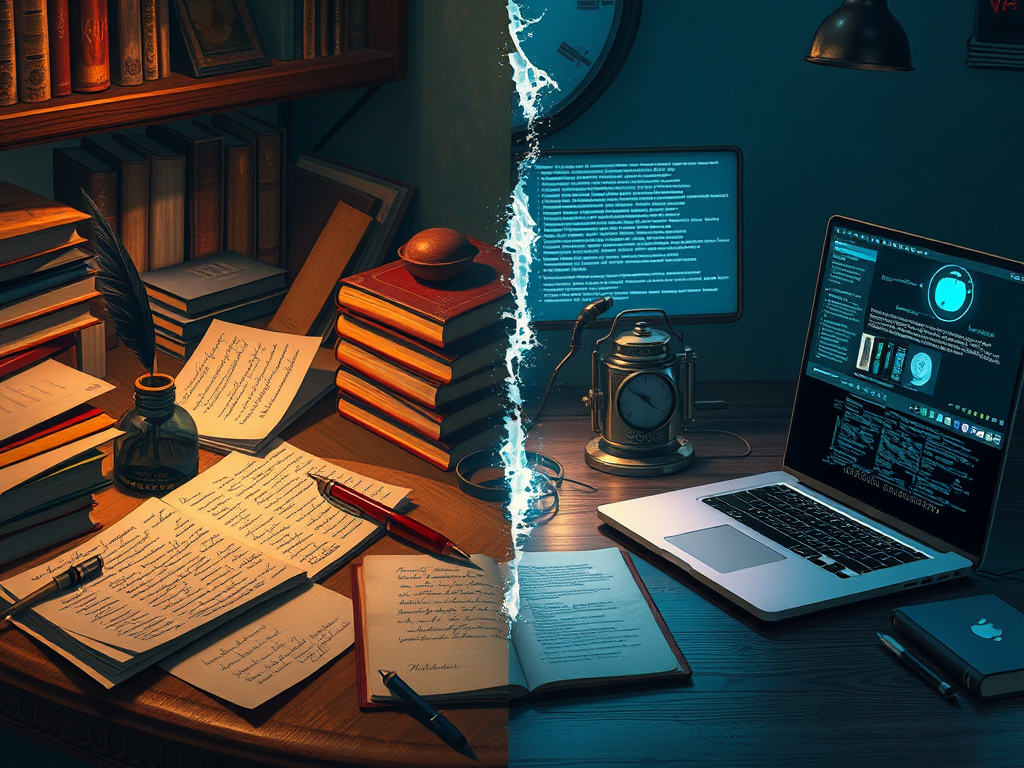
rom Personal Expression to Generic Text: The Dilemma of Writing in the Age of AI
For centuries, writing was a deeply human act. A space where personality, mood, and intention filtered through every chosen word, every grammatical twist, every pause. From the most intimate poetry to everyday correspondence, the way a person wrote was as unique as a fingerprint.
Today, however, we find ourselves at a crossroads. Generative artificial intelligence, led by ChatGPT, is breaking into this sacred space with a tempting promise: to write for us—faster, more accurately, and with no effort. But this assistance comes at a cost that we are only beginning to understand.
The Hidden Price of Automated Writing
Beyond the obvious debates about the environmental impact of the massive data centers powering these models, or concerns over the privacy of our personal data, there is a more subtle yet equally profound unease: what is happening to our minds?
Researchers and linguists are starting to question whether excessive use of these tools is affecting our brain activity related to text production. When we delegate word choice to an algorithm, are we weakening the neural circuits responsible for linguistic creativity? It is the paradox of convenience: the easier it becomes to generate text, the less we exercise our own ability to create it.
The Silent Uniformity
The phenomenon already has a name in certain circles: “ChatGPT style” is being discussed. That neutral tone—correct but bland—that seems to flow from the same source no matter who requests it. Bold metaphors, risky grammatical constructions, local idiomatic expressions… all tend to disappear in favor of functional, understandable text that is devoid of soul.
What was once an act of personal expression becomes an exercise in editing. We no longer write; we curate content generated by a machine. We choose from predictable options instead of creating from the void of a blank page.
Where Are We Heading?
Perhaps, in the grand scheme of things, the loss of certain stylistic nuances may seem like a small price to pay compared to the environmental or ethical challenges posed by AI. But the way we write is the way we think. And if we allow our writing to become homogenized, we run the risk of our thinking becoming homogenized as well.
The question is not whether ChatGPT can write like us. The question is whether we, accustomed to its help, will still be capable of writing like ourselves.
By: Nestor Castillo, ForAllTechNews Director