
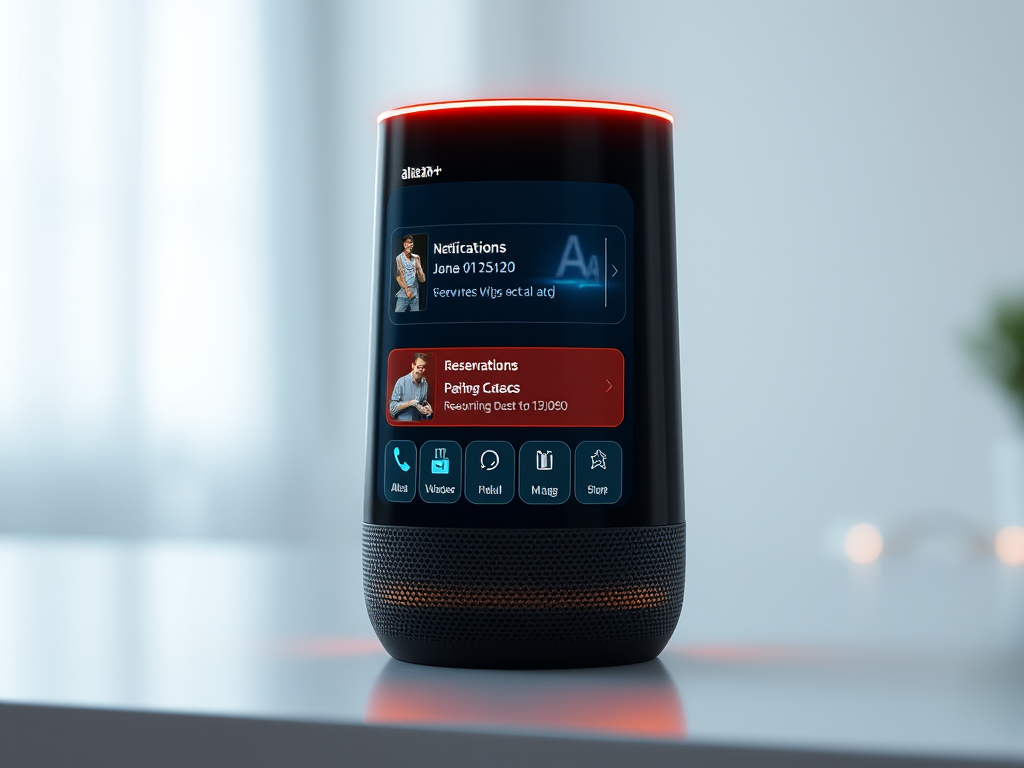
Amazon is driving interoperability among AI agents and the combination of multiple models to improve the effectiveness of its voice assistant, Alexa. The new version, called Alexa+, incorporates advanced navigation and task management capabilities, making it a smarter and more proactive tool. For example, Alexa+ can notify users about updates, such as the release of a book by their favorite author or nearby concerts by their favorite artists, and even suggest purchasing tickets. Additionally, it can handle complex queries, such as finding the nearest pizzeria to the office, evaluating if it’s suitable for colleagues, and making a reservation if necessary.
Alexa+ combines AI agents, web navigation skills, and Amazon’s vast ecosystem to deliver a more capable assistant. Currently, it operates with Amazon’s Nova models and Anthropic’s models, but Amazon plans to keep it “model-agnostic,” allowing the integration of other systems available on Amazon Bedrock to optimize its performance.
What is Model Blending?
Model blending involves selecting the most suitable AI system for each task, optimizing costs and efficiency. Amazon Bedrock has introduced a feature called Intelligent Prompt Routing, which directs queries to the most appropriate model. This flexibility is key to Alexa+’s future, as it will be able to evolve with the best available models.
Interoperability and Agent Coordination
Alexa+ integrates agents in three ways: through traditional APIs, agents with web navigation capabilities (like those from Anthropic), and connections between agents. At the core of this system are advanced language models (LLMs), which orchestrate these interactions. Additionally, Alexa+ can interact with external agents, even if they are based on different models.
Mike Krieger from Anthropic highlighted that recent advancements in models like Claude 3.7 Sonnet, available on Bedrock, have been crucial to achieving Alexa+’s capabilities. However, earlier versions would not have been able to handle such complex tasks.
The Impact of Generative AI
Assistants like Alexa, Google Home, and Siri were pioneers in bringing AI to the public, but the advent of generative AI has raised expectations. Users now demand real-time responses and smarter solutions. Amazon acknowledges that this technological advancement has allowed Alexa to reach its true potential.
Panos Panay from Amazon noted that previous technological limitations prevented Alexa from being all it could be. With Alexa+, the company hopes to continue improving the assistant, incorporating new models, and making more people trust its capabilities.
In summary, Alexa+ represents a significant step in the evolution of voice assistants, combining advanced artificial intelligence, interoperability, and navigation to deliver a more intuitive and useful experience.