
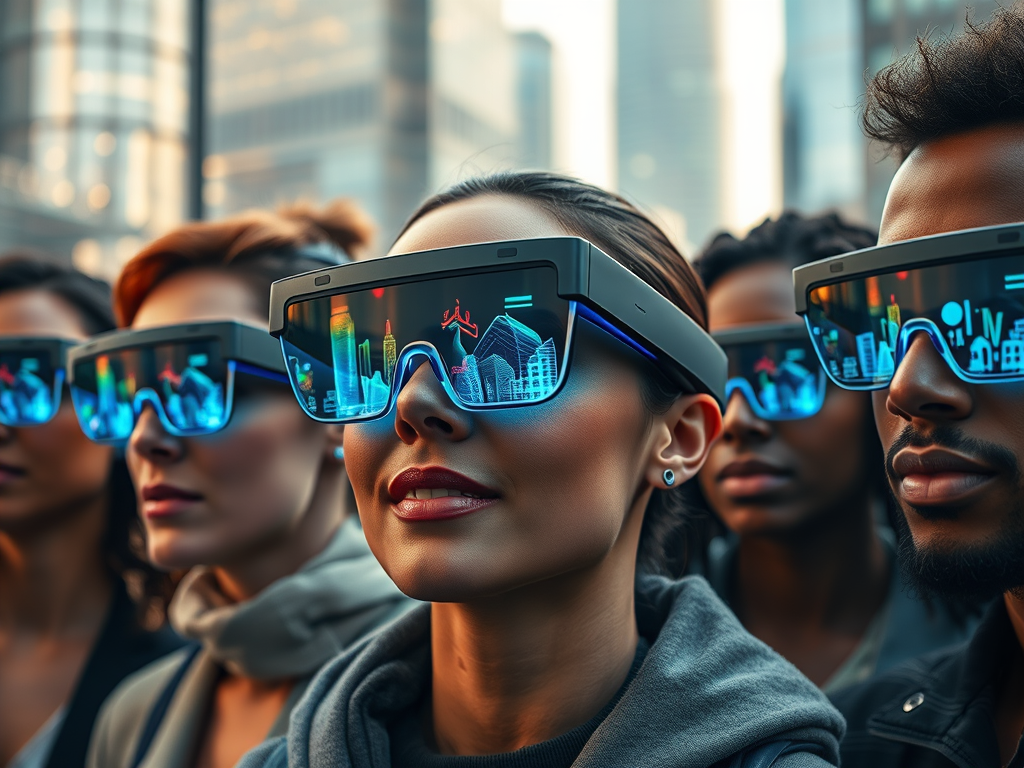
Do you think you’ve seen a real hologram? Think again…
In the iconic Star Wars: A New Hope movie from 1977, R2-D2 projects a beam of light to create the legendary holographic image of Princess Leia asking Obi-Wan Kenobi for help.
Nearly fifty years later, technology has yet to deliver the real holograms promised by science fiction, let alone flying cars or teleportation devices.
While products like Microsoft’s HoloLens or Apple’s Vision Pro are impressive, they merely create optical illusions using transparent screens. Even the famous “live” Tupac performance at Coachella was a trick known as Pepper’s Ghost, far from being a genuine hologram.
A real hologram redirects light to form 3D floating images visible from any angle, much like Leia’s projection. This exciting technological field is being explored by companies aiming to bring it to market. One of the leaders in this space is Swave.
Founded in 2022 in Belgium, Swave emerged from the prestigious nanoelectronics research center Imec. The company claims to have created the first technology capable of producing true holograms using its Holographic eXtended Reality (HXR) system, which sculpts light waves into realistic 3D images.
Recently, Swave raised €27 million in a funding round led by the Belgian fund SFPIM and Imec’s venture capital arm, imec.xpand. This brings their total funding to €37 million, including €10 million raised in 2023.
“This investment will allow us to accelerate the launch of our products to market as we continue to overcome the limitations of current augmented reality experiences with authentic holography,” said Mike Noonen, CEO of Swave.
The company’s first product will be an ultra-lightweight pair of smart glasses designed to surpass current technologies. These glasses feature an advanced display that uses phase-change materials to sculpt light into 3D images visible from all angles.
With the smallest pixels in the world, measuring less than 300 nanometers, the images produced are sharp and don’t strain the eyes. Swave’s ultimate goal is to develop applications that pass the visual Turing test, where virtual images are indistinguishable from reality.
To generate vivid colors, the glasses use a spatial color system that arranges color filters on a single panel, reducing visual artifacts and optimizing battery life.
The company states that its product, still under development, will offer a broader field of view and better depth of focus compared to existing devices, while being significantly smaller and lighter.
These glasses also address common issues in augmented and virtual reality, allowing users to adjust holograms to their vision, dynamically shift focus, and avoid side effects like nausea or headaches.
Fueled by its recent funding, Swave is preparing for its first product launch.
“With Series A funding secured and our silicon in production with manufacturing partners, we are on track to release development kits and, shortly after, commercial devices,” explained Dmitri Choutov, Swave’s co-founder and COO.
Additionally, Swave is working on HUD displays for vehicles and a spatial light modulator that would enable holograms without glasses. This innovation could bring us closer to R2-D2’s hologram—or perhaps even surpass it.
By: Nestor Castillo, ForAllTechNews Director