
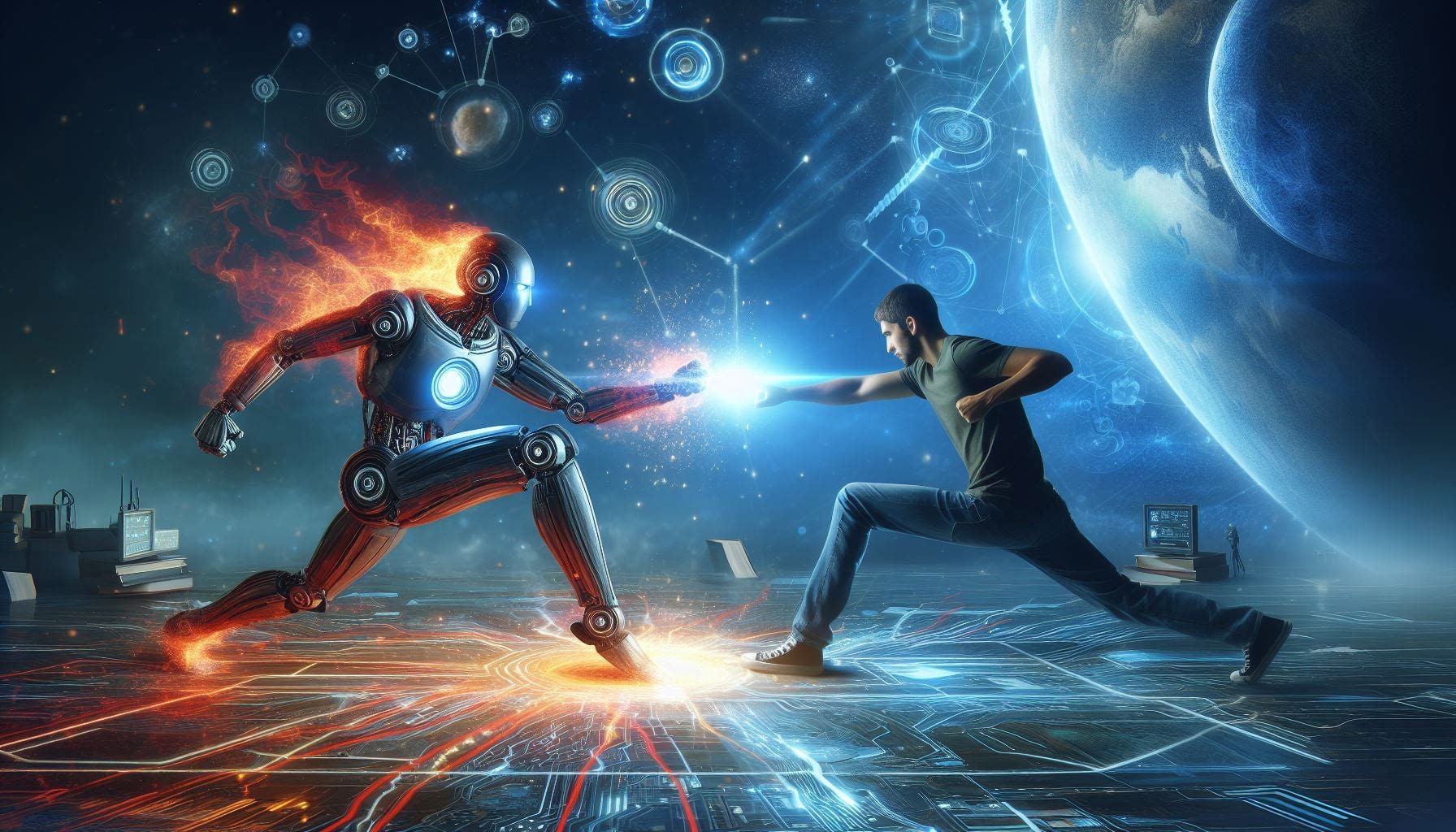
Despite their futuristic appearance, robots are relics of the past. Their focus is always directed backwards, and this is especially evident in the AI Generation. Following Max Ernst’s Dada aesthetic of collage, AI can only create the new by combining old elements. Recently, Annie Leibovitz caused a stir by stating that she did not care about AI. However, putting aside the bad taste of a wealthy person reassuring the less fortunate, she is right. Although technological advances will continue to happen and creatives will adapt, there is a valid reason to be concerned about the current state of the creative industry. Perhaps the underlying fear of this disruption lies in the possibility that we have not been truly creative for a long time.
As we move closer to understanding, we recognize that we live in a brief period where creatives were forced to adapt to a technical environment. During this time, the term “User Experience” (UX) was in flux, but far from being a universally stable and permanent concept, it turned out to be a period of transition. As in any time of change, some things that seemed stable proved not to be, while others that were considered temporary became more permanent. There was a time when software needed an interpolation layer to translate human intent into data, but that time is coming to an end.
Human beings, generally speaking, face difficulties with change. Our brief existence on this planet, combined with our limited perspective and the influence of those closest to us, makes us notoriously unsuitable for long-term planning and vision. However, we compensate for this limitation with a remarkable ability to adapt. My optimism is based on the idea that our history resembles a continuous cycle, where we face problems and find solutions again and again. Although we don’t always get it right, we get it right enough to survive and sometimes thrive.
Regarding the relevance of tools, when a tool becomes obsolete, those who only master that tool are at risk. I have advised the designers I have had the fortune to interact with that their worth should not depend exclusively on a specific tool. It’s easy for the young and impressionable to assume that current tools, like a hammer and drill, will be relevant throughout their lives. However, history shows us the opposite. ActionScript experts, for example, can attest to how their specialization in that tool has become less relevant over time.
In the analysis below, we will explore how digital work dynamics have evolved over time. Before 2006, working in the digital space was very different. Creatives were wearing multiple hats due to a lack of best practices, insufficient resources, and the experimental nature of the industry.
However, as more investment and players entered the field, projects became more complex and codebases more intricate. New demands emerged, such as project architecture and visual design, requiring specialized skills. Creativity, once unlimited, was restricted and codified for commercialization.
Design platforms, like Figma, emerged to serve designers and standardize processes. In this context, Big Data was presented as a solution to resolve chaos, offering precise answers. However, we must also recognize that systematization has its risks and can smooth the rough edges of innovation and creativity.
“I’m reluctant to upgrade my operating system, I don’t rush to buy the latest equipment, and I experience some fraud when I see something new.”
When experts started debating the differences between Generation AI, I wasn’t impressed at all. I considered large language models (LLMs) to be primarily predictive, based on previous data. Interesting, but not something that would make me lose my mind. However, what artificial intelligence has achieved in the last 6 months has left me in awe and makes me optimistic about long-term trends.
While we deeply regret the job losses and changes to the lives of millions of people, we must recognize that the advent of generative AI has completely removed the marketing layer of user experience middleware. Every design system created in Figma, every standard pattern in a prototype, and every GitHub ticket to suggest a hex color change can be managed by a bot. And the most important thing.
Before, we do not need to wait for a generation of superior AI to bring about this radical transformation. It’s already here, now. There’s a reason why LinkedIn is currently the most daunting website in the world.
The incorporation of AI in the field of design has generated some strange situations. Suddenly, many of the “routine” tasks in our jobs have become commercial. All that time spent on trivial searches and snooping around for things? That is now a thing of the past. The AI took care of it. The bot is like an always awake, anxious and probably hyperactive internal assistant. The bot doesn’t get tired. The bot doesn’t mind your clumsy syntax. The bot has no preferences about what you want for dinner. The bot is here and ready to help. Forever.”
We come from four decades of recycling as a predominant cultural product. Remixes, reboots, nostalgia-laden retrospectives and the absolute plundering of the past are the defining features of this era. Kurt Anderson, in his book “Evil Geniuses”
In that period, the United States moved away from novelty on two distinct but interconnected levels. Culturally, it fell into a massive nostalgia that transformed into cultural apathy. Life, which once looked, felt, and sounded new, experienced a slowdown. Americans of the 1950s and 1970s seemed to come from different worlds, while Americans of the 2000s and today don’t look all that different.
My intuition tells me that we are exhausted, deeply tired of this creative regurgitation being the center of attention. How many Ghostbusters reboots do we need? How many reissued albums are essential? To what extent can artificial intelligence recycle designs that vaguely resemble what we’ve already seen, before we long for something fresher? We have passed the initial phase and now face fatigue. Pornographic deepfakes, cheerful but meaningless illustrations, clever but soulless photographs: all this has become as common as a road sign. As in any market, the value of these items has plummeted to almost zero. And when a market approaches a zero valuation, an opportunity arises for those who dare to stray from the beaten path.
These two forces, the degradation of artisanal creativity due to standardized tools and the onslaught of artificial intelligence, have created a wide space for real human beings. If you were a writer of utopian fiction, you couldn’t imagine a more promising beginning. I’m beginning to believe that we are on the threshold of a new renaissance in design, art and creativity.
Certainly, we will face a crucial and close conversation about whether creative, open, human-generated dialogue, despite its deeply offensive and problematic content, will surpass “familiar” AI channels. While I can’t predict with certainty how this dilemma will be resolved, let’s remember the basic lessons from Economics 101: Inexhaustible, cheap supply will prevail at the lower end of the market. In my opinion, humans will occupy the upper segment, but to stand out, they will have to be inherently unique and provide superior value.
In my previous job, I supervised people who managed design systems. It was a fun experience (people did it that way!), but it didn’t always involve creativity itself. Now, in my new job, every day I immerse myself in an eclectic mix: user experience (UX) design, illustration, sound design, and consulting with our user researcher. Figma cannot address this diversity, and neither can ChatGPT. However, this is where my current value lies, and I enjoy it, although I admit it is more of a challenge.
In short, this represents the new era of digital creativity: a terrain where versatility and uniqueness intertwine to generate fresh and valuable ideas.
In reality, the process of training people is more like creative collaboration than hierarchical management. By incorporating individuals capable of filling the creative gaps we desire and appreciate, we create a true creative collective. However, we must recognize that achieving a genuine creative vision is a considerable challenge.
As for the debate about pessimism related to artificial intelligence (AI), I think it is somewhat absurd. When people express concern about robots taking over, they are really questioning whether humans will be foolish or malicious enough to allow that to happen. While I don’t deny the existence of the problem (my own chance of “doom” is a solid 11%), I’m confident that ultimately we’ll be fine. As a great ally for humans, robots will prove competent enough to go unnoticed. Although the transition will be arduous and will require learning new skills (or perhaps rediscovering them), abandoning old habits and building a new paradigm, I believe we are prepared to meet this challenge.
By: Nestor Castillo, ForAllTechNews Director