
The beginning of 2026 has been marked by significant public health decisions. Following a change in childhood vaccination recommendations, the U.S. government this week released an update to its official dietary guidelines, which has ignited intense debate within the scientific community.
These guidelines, which influence school meal programs and social assistance, show a notable shift by more emphatically promoting the consumption of red meat, butter, and animal fats like tallow—products that numerous studies link to cardiovascular risks when consumed in excess.
A Questioned Process
Since the 1980s, these recommendations have been revised every five years through a rigorous process: an independent scientific committee spends years evaluating available evidence and publishes a foundational report, upon which the final guidelines are based. For the 2025-2030 cycle, this report was published in 2024 after extensive work. However, the final version released this week appears to distance itself from its conclusions.
Many experts had expected the new guidelines to incorporate recent findings, such as the lack of a “safe” level of alcohol consumption, the risks of ultra-processed foods, or considerations of environmental sustainability. These expectations were not met.
An Anachronistic Food Pyramid
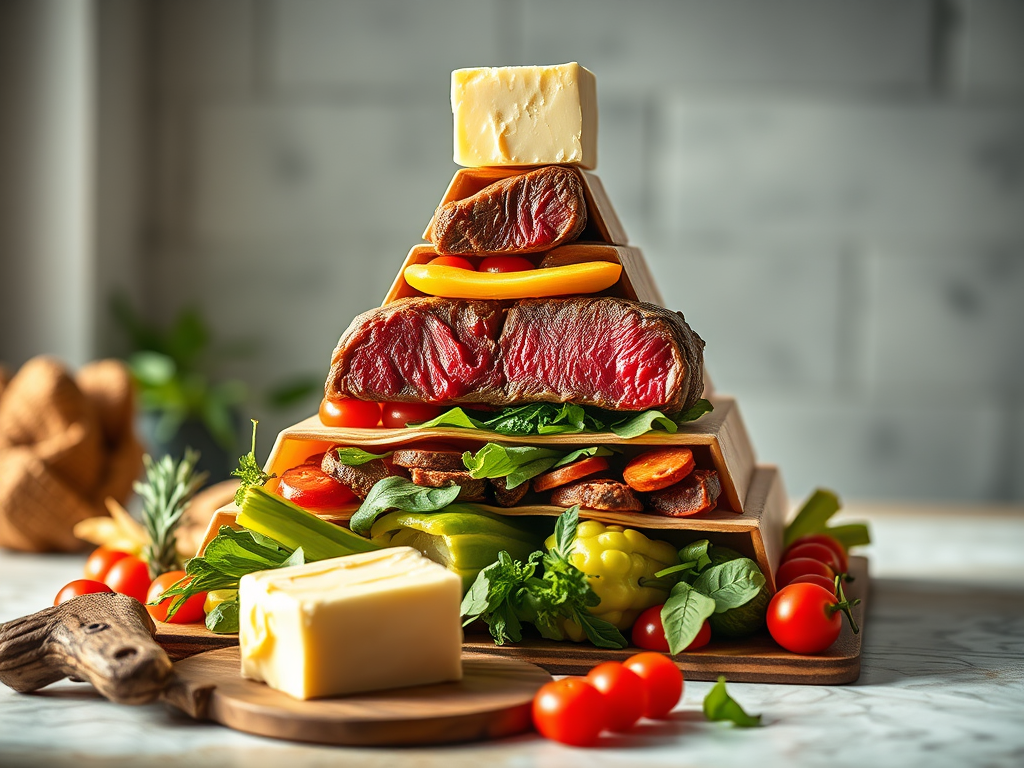
One of the most criticized aspects is the reintroduction of a food pyramid as the main graphic. Nutritionists abandoned this model over a decade ago, deeming it confusing, and instead adopted visual representations like “MyPlate,” which clearly illustrates how to compose a balanced meal.
The new pyramid gives prominent space to meats and full-fat dairy. Images of a steak and a stick of butter are featured at its top, which, according to critics, sends a misleading message about their dietary priority. While these foods can be consumed in moderation, their association with saturated fats and potential health risks is well-documented.

USDA
Recommendations Under Scrutiny
The definition of “healthy fats” now includes butter and beef tallow, despite their significantly higher saturated fat content compared to alternatives like olive oil. Furthermore, the daily protein recommendation is raised to a range of 1.2 to 1.6 grams per kilogram of body weight—a substantial increase from previous editions that, according to some specialists, could lead to excessive calorie and fat intake.
The section on alcohol merely suggests “drinking less” without specifying limits, despite growing evidence of its harmful effects. Sustainability aspects are also not addressed, omitting the environmental impact of meat and dairy production.
Discontent in the Scientific Community
Several researchers who contributed to previous reports declined to comment publicly on the new guidelines, though some expressed reservations about the transparency of the process. The general feeling among many specialists is that decades of research have been partially ignored in favor of an approach that does not reflect the current nutritional consensus.
“It is disheartening to see how thorough scientific work can be replaced by rushed recommendations,” commented a researcher in the field, who requested anonymity. The discrepancy between the scientific basis and the final recommendations leaves a pending question: on what evidence are these changes based?
By: Nestor Castillo, ForAllTecheNews Director