
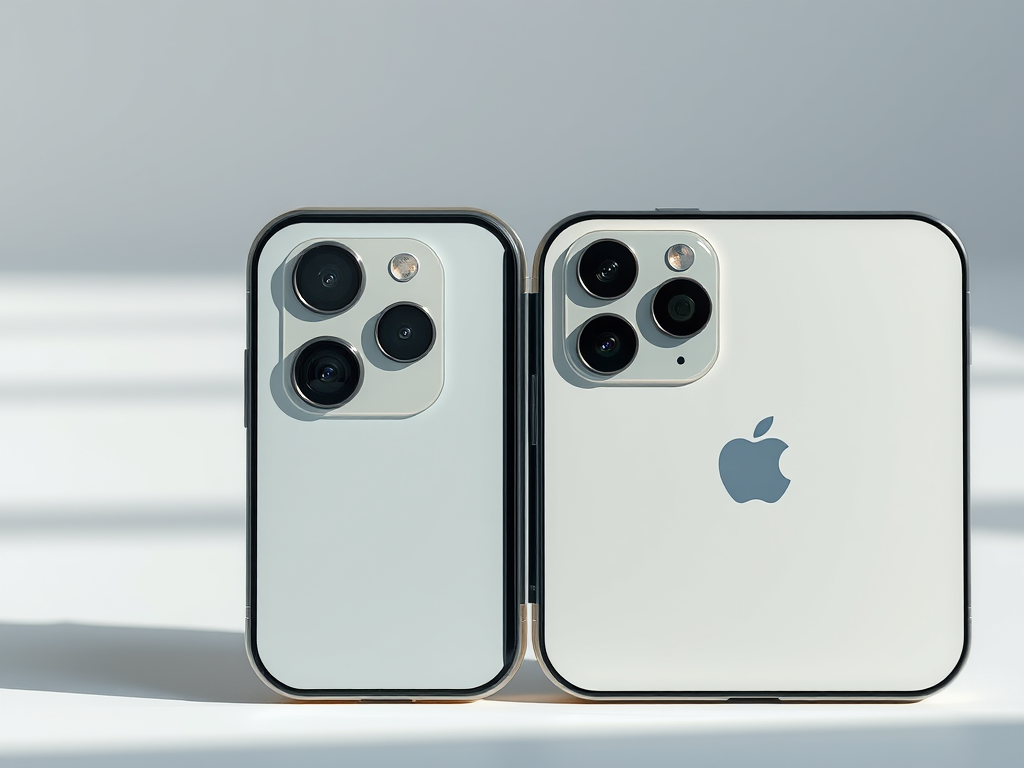
According to the latest revelations, Apple’s first foldable iPhone, scheduled for release next year, will integrate advanced technological features and an innovative design. As reported by Mark Gurman in Bloomberg’s Power On newsletter, the device will feature a four-camera system, incorporate Touch ID fingerprint recognition, and be equipped with Apple’s in-house cellular modem.
The foldable iPhone’s design will follow the book-like format, similar to many Android models, with a larger interior screen. When closed, it features an external display between 5 and 6 inches, allowing it to be used like a conventional iPhone. The camera system includes a front lens, another on the inside of the foldable screen, and a duo of rear cameras. The main rear camera is expected to offer high resolution, while the secondary one could feature ultra-wide-angle or telephoto capabilities, although this detail has not yet been confirmed. A fifth lens will act as a selfie camera when the device is unfolded, taking advantage of its 8-inch interior display.
The choice of Touch ID, instead of the Face ID used in other flagship models, is due to space constraints. The reduced thickness of each half of the device—less than 5mm—makes it difficult to integrate the complex TrueDepth system required for facial recognition. Therefore, Apple has chosen to incorporate a fingerprint sensor into the side button.
Regarding connectivity, the foldable iPhone will use the next-generation Apple C2 modem, which promises higher transmission speeds. Like the iPhone 17 Air—also planned for 2025—this model will not have a physical SIM card slot in any region, following the trend towards the exclusive use of eSIM.
Although it is anticipated to be a highly sought-after product, its price will likely be above $1,800, in line with high-end Android foldable devices. At its initial launch, it will only be available in white and black. Mass production will begin early next year, with public availability expected in the fall.
In parallel, Apple would continue to innovate in its conventional line: the iPhone 17 is expected to feature a design similar to the current one, but with a redesigned rectangular rear camera module, while the rumored iPhone 17 Air will be distinguished by its exceptionally thin profile. For 2026, in addition to the foldable model, a significant redesign of the iPhone Pro with a body constructed entirely of glass is planned.
By: Nestor Castillo, ForAllTechNews Director